
Form
This project reinterprets the equestrian term "form", a record of past performance used to benchmark future potential, as a framework for creative self-reflection. By auditing my first three years at the Glasgow School of Art, I used my own academic history as the foundational dataset for this work.
Workflow & Digital Fidelity
Using source imagery from three benchmark past projects, I converted the visual assets into vector files to serve as structural blueprints for 3D generation within Blender.
To maintain conceptual honesty, the design direction deliberately eschews traditional photorealism. Instead, the final sculptures preserve their native, computational aesthetic—celebrating the raw geometry, artefacts, and true materiality of the digital medium.


Return to Form
Upon revisiting these three digital sculptures, the objective was to translate them into environments in which they could be experienced alongside traditional physical sculpture, while exploiting the unique advantages of fully controllable digital spaces.
Form One | Virtual Reality & Spatial Scale
Characterised by intricate tunnels and deep cavities, Form One inherently demanded spatial exploration. Virtual Reality (VR) was selected as the optimal medium, enabling users to navigate around the asset in real time. To play with scale and perspective, the installation features a monumental version floating overhead, contrasted against a miniature twin that users can peer into within the same immersive space.
Form Two | High-Definition Printing & Vitrine Display
Because Form Two features highly detailed, standalone strands frozen in space, the piece required a medium that invited close inspection. In collaboration with the Photography Printing department at GSA, high-definition renders were materialised as physical prints. Exhibited within a traditional gallery vitrine, this approach grants the viewer the necessary time and stillness to absorb every macro detail.
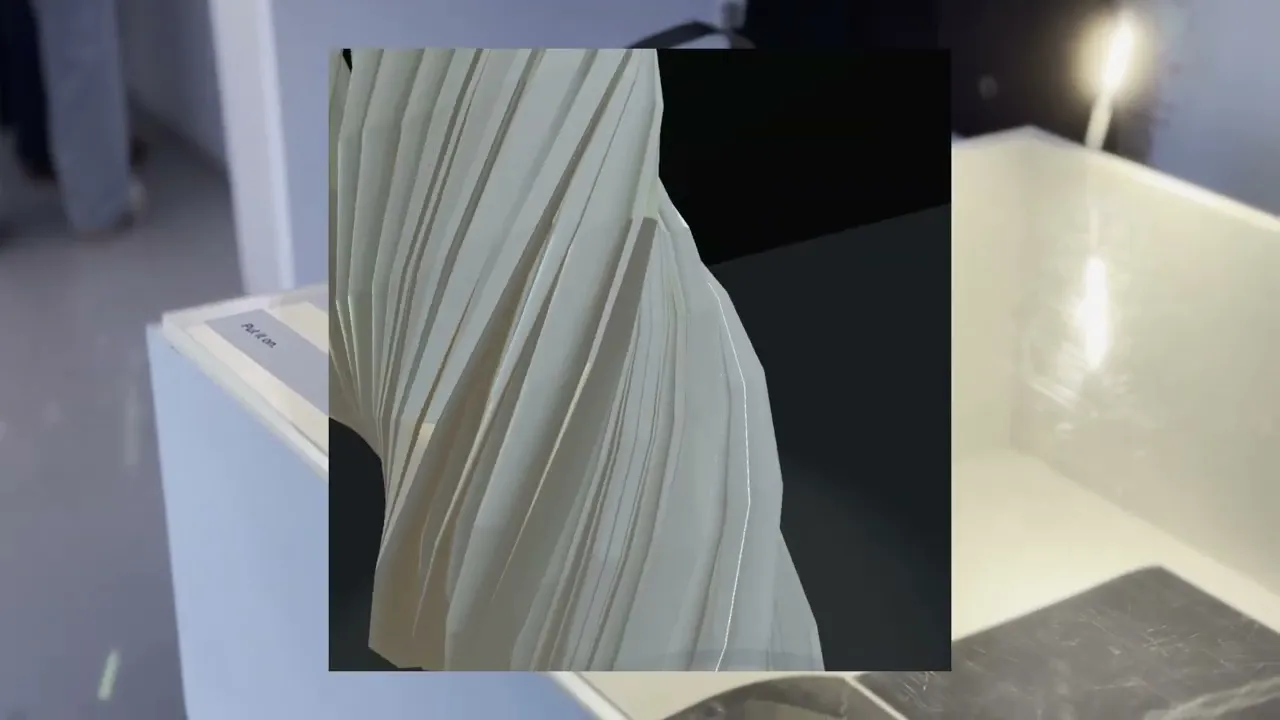
Form Three | Augmented Reality & Tablet-Window UX
Featuring a complex, pipe-like anatomy with dense internal wall details, Form Three required a flexible exploration mechanic. Augmented Reality (AR) was deployed to solve this, utilising a tablet interface as a portal into the digital realm. This approach gives users intuitive, physical control over their field of view, allowing them to inspect the digital asset at their own pace in a real-world context.


